Minggu, 15 Juli 2007

Summer's Berries

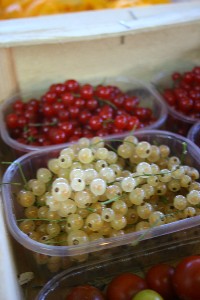
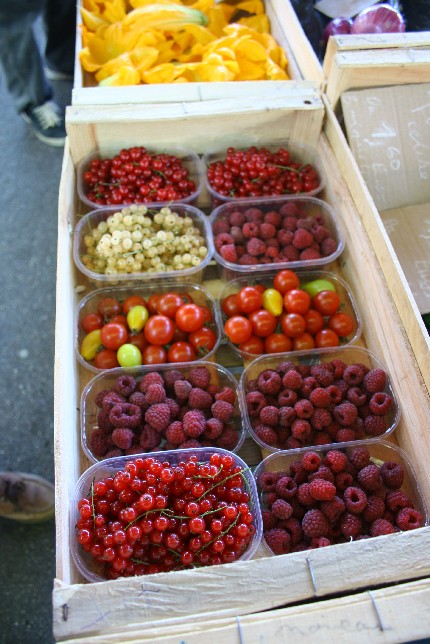
We often see white currants, sometimes dusted with confectioners sugar, as a gorgeous garnish on the beautiful cakes and cream desserts here. This week I made cheesecake, adding a summer twist of a tablespoon of fleur d'oranger to flavor it, and serving it with fresh raspberry coulis. Guess what went on top of each serving?

There is something in the way they glow in the morning light that attracts me.

Kamis, 12 Juli 2007

Serpolet - Wild Thyme


A blue butterfly came and sat on my shoulder while I was hiking and I thought of the fleeting beautiful gift that life brings to this species. Imagine suddenly being able to see the world from a whole different perspective. Once a worm, dwelling in dark places and hibernating underground, and then suddenly a gorgeous fluttering burst of life occurs. What a contrast! The same creature is at once able to fly from flower to flower, sip precious nectar, feel the wind in its wings and bask in the sun. Did you know that the blue butterfly's sole sustenance is serpolet, or wild thyme?

Serpolet, or wild thyme, is an herb that is generally available from one vendor at the Saint Antoine market in the summer. I use it for many preparations. It pairs well with the chanterelle mushrooms that are coming out now, with lamb, in rabbit terrines, with quail brochettes, even with seafood like stuffed squid or mussels. It grows abundantly naturally, in dry rocky soil, so we see it a lot in the mountains and also along the coast. I had guests for lunch and put some of my leftover flowers on the table for everyone to enjoy at the table. They went straight back to the kitchen when I cleared the table, to live a second life in food.

I have ground the blossoms and leaves to a paste and massaged four souris d'agneau (lamb shanks) with it. They will marinate in the herb for a day before receiving a glazing of green chartreuse. After another two days being turned now and then in their herbal liquor marinade, I will pierce them with garlic cloves and season them with salt and pepper, the last step before I either braise or spit roast them for dinner with friends. But of course you will see the end result! Yes, I also have several recipes for vegetable dishes using Serpolet in my kitchen notebook. I promise to share them.

Senin, 09 Juli 2007

Cool, Smoky Gazpacho

My friend Clare was getting ready to teach a yoga class when we last talked and it got me thinking. She was going to be teaching something called yin yoga. What is yin, you ask? The whole idea centers around elements to cool, calm, and center you in spirit and mind, as a compliment and grounding element to those that actively stimulate you. Stimulation is good, but sometimes you need to tone it down a bit with some calming elements. There are lists of foods labeled yin and others which are yang. The best cooking will of course incorporate a balanced combination of both yin and yang. You've got to have a balance.

I understand it is hot and sticky back home, while we are walking around in trench coats and sweaters here in France. But for Clare and Mom, both languishing in the current heat wave back stateside, I want to share a recipe that might cool you off with some yin and at the same time give you a little spank of yang to keep you moving.

A nice house Gazpacho can be put together in the morning before you start the day. It takes all but 10 minutes to do and it really hits the spot once the sun is high. It can be served as a first course or as a meal with fresh bread, followed by the cheese plate.

I guarantee that this soup is the one that will win over a staunch cold soup cynic. It was entered years ago into my kitchen notebook after I tried the one in the good old standby, the Silver Palate Cookbook. If you have the cookbook you'll see that I have deviated completely from it over the years. It no longer even resembles the original recipe. But I like to attribute my ideas. Quand meme!

Cool and Smoky Gazpacho

This recipe will serve 4 to 6, depending on what course you serve it in.

6 of the most flavorful ripe tomatoes you can find
1 yellow onion or a bunch of mild flavored onions, the kind you get in spring and early summer
1 red bell pepper
1 yellow bell pepper
1 large cucumber
2 shallots
1 celery branch, cut into chunks
1 dried chipotle chili (a dried, smoked, jalapeño from Mexico). Note, if you don't have this kind of pepper, get some, silly! I will not be held responsible if you don't get yourself a chipotle pepper!
1 or 2 teaspoons coarse sea salt (cold food needs salt)
1 1/2 cups mixed poultry stock (had to get meat in there somewhere! Ha!)
-or- 1 1/2 cups of your favorite prepared vegetable bouillon
1/2 cup hot water for the chili pepper
2 limes
up to 1/2 cup good fruity olive oil (optional, depends on your regime)
1 bunch of chopped fresh dill weed or cilantro
4 to 6 tsp. wine or basalmic vinegar (your favorite vinegar) for serving

About the chipotle: This is a kind of pepper that is available everywhere in the USA! Dried and smoked jalapeño peppers from Mexico, I adore them. They not only add a complex, manageable heat, but also add amazing breadth of flavor with their natural smoke. If you haven't discovered chipotles, it's high time you did. If you cannot obtain the dried ones, you can use a canned one, the kind in adobo. If you live in France and are set on making this soup but have no peppers, call me and I'll send you one of mine.

- Wash and cut the tomatoes, onion, celery, bell peppers, cucumber, and shallots into rough chunks and put them into a large bowl or a soup pot.


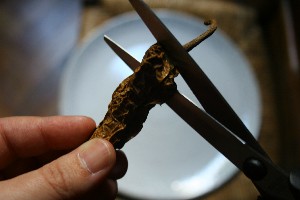
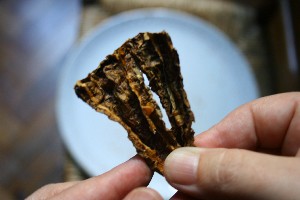
- With scissors, cut the top from your dried chili pepper and slice it down the side, opening it to reveal the seeds and strings. Remove the seeds and pulpy strings from the inner part of the dried pepper (some may call this heretical behavior, so this step is of course optional, but note that you can keep the heat to a nice afterglow by doing this).
- Heat the 1/2 cup water to boiling and remove from heat source. Immerse the chipotle into it. Set it aside to soak.
- Take the stick blender to the vegetables. Concentrate on the onions, celery and shallots first, then the tomatoes, then the peppers and cucumbers as you blend the vegetables, not aiming for a totally homogenous puree, but leaving little chunks and crunchy bits here and there.
- In another container like a large measuring cup, put the poultry or vegetable stock, the entire chili pepper and its smoky flavored soaking water, and the salt.
- Puree the liquids with the pepper until the chili pepper is completely pureed and is like little specks in the liquid. Break down that yang. Add it to your cold vegetable puree. Add the juice of two limes, the olive oil, if you're using it, the chopped fresh dill weed or cilantro, and stir.
- Transfer to large jars or just cover the bowl or pan and refrigerate a few hours or overnight.
- Stir before serving and drizzle a teaspoon of the vinegar of your choice on top of the cold soup in each bowl. Don't forget the vinegar when you serve it.

Jumat, 06 Juli 2007

Blessed are the Little Ones

20 minutes south, 20 minutes north
-
Sometimes the cheese freak show comes to town. They roll in during the vacation periods, when the regular vendors have left spots to fill, and they roll out an enormous wheel of Beaufort. Tourists come and stand in front of them to have their photos taken, and then get fast talked into buying some.

Put that huge cheese out of your mind for a moment. Imagine arriving to the market and hearing a different call. "Step right up folks, right this way! Here we have the smallest wheel of cheese in the world!"

Sounds a bit odd, you say? One day a few years ago I started thinking about small cheeses. A whole new delectable universe opened up to me. There are quite a few different cheeses that I could easily put on the table in the kitchen of my dollhouse, and they would look right at home there. Sumptuous and grand. But at the fromagerie they are so small, they can be easy to overlook. Don't let the little ones pass under your radar, folks, you'll be missing something special.

actual size
-
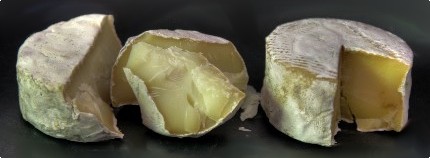
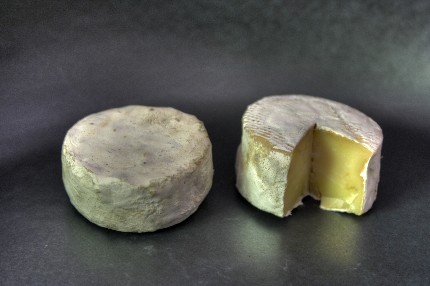
One of my favorites of the lilliputian stature is a local raw goat’s milk cheese called the Rigotte de Condrieu (the cheese on the left). It rarely weighs more 30 grams when fairly new, and the fromager gets them in palettes and takes it from there. With time, it shrinks down and dries until it splinters when wedged into delicious little shards of pleasure. You can get it at all stages of affinage. I prefer mine rather dry, because it’s then that the cheese takes on a beautiful balance between tangy and creamy. My idea of heaven is a nice Rigotte de Condrieu with a glass of St. Joseph, preferably at sunset when there's nothing to think about but how the sun makes it glow.

Most of the other rigottes are made of cow’s milk, and there are many kinds to choose from. A very good one is the Rigotte des Monts du Lyonnais (on the right), from the other side of town, about the same distance north from Lyon as Condrieu is to the south. It also ages quite well but I prefer this one younger than I do the Rigotte de Condrieu.

There is a fromager at Les Halles called Marechal on cours Lafayette that tends to the little ones extremely well. They have really got it down to a science. They also have really good connections, and source many of the little cheeses that you just won’t find elsewhere. I always go to Marechal when I want itty bitty little cheeses for the plate because no one does them better.


For the little cheeses:
Fromagerie Maréchal
Halle de Lyon
102 cours Lafayette
69003 LYON
04 78 62 36 77

Le Clafoutis

You never know if people you know are clafoutis purists - i.e. do they take life's bowl of cherries pits and all and insist that everyone else does too - or are they the kind to do what they can to enable quick painless gobbling activities in their entourage, thus removing the pits before putting the cherries in?

You'd be surprised at the way a normally mild mannered, friendly and generally laid back person can turn into a rabid dog and go for your throat should you even mention removing pits for a clafoutis. This is one of those pressure points in the French human psyche that are so completely unpredictable and random. My warning to you is to tread lightly, my friend.

I know now never to even breach the subject, for example, with my hairdresser when he is holding scissors, lest he purse his lips and then lapse into a daydream before he reasserts his opinion that the pits must be left in the fruit. No mind that I agree with him completely, except for the fact that I always add the "to each his own" clause. Just the mention of this clause and something begins churning in his mind and unpleasant memories are triggered about the errant clafoutis cook that fell to the wayside in his childhood and removed the pits. It's enough to start him tersely clipping away, with such vehement conviction that I must change the subject entirely or end up with a bad haircut.

Me I am a pits in the cherry kind of gal - but try very hard not to impose my opinion on others. In my opinion, pits are part of the package, integral to the full experience of the clafoutis. I have heard that the juice runs into the custard and clouds it up if you break the cherries open to remove the pits, but I have also heard that if you freeze pitted cherries before putting them in, then you can have the best of both worlds with a nice clean looking custard base.

What's wrong with a few pits? What doesn't kill you will make you stronger. You don't eat them, anyway, you spit them out. I suppose the people who prefer their clafoutis with the pits removed would also be the kind to dislike eating tacos or long noodles or remove the bones from their chicken. But it's good! You let the custard melt on your tongue and rub the fruits against the roof of your mouth, and the whole fishing for the pits sets things in motion for complete and perfect enjoyment of this classic French dessert. On the other hand, you're free to do it however you like. I won't judge you.

Senin, 02 Juli 2007

The Mystery of the Pyramids


One look at the luscious pyramids of chevre that appear in artisan form from all regions of France and I begin to tumble the mysterious shape and its history like a puzzle in my mind. Why pyramids for goat cheese?

Baskets are hung to favor the quick elimination of whey, it might be easy to dismiss the whole issue as just the preferred method for cheese-making in general, but then again the pyramid shape seems to be classically linked to cheese coming from goats. If it were a question of the mechanics of cheese in general, we would not think "chevre" when we see this shape.

The truncated pyramid shape (above) is said to have its origins in Valencay, inspired by Napoleon Bonaparte's dinner in the countryside with his interior minister, Talleyrand. When presented with local cheeses, the story is that Napoleon commented on the tall pointed pyramid shape as reminding him of his campaigns in Egypt. His host followed the next day with a delivery of six truncated pyramid shaped cheeses, and it has been made that way ever since.

An alternative and more exciting version of the story is that the little conqueror took out his sword and violently chopped off the tops of the cheese right then and there at dinner, in a fit of rage. As a counterbalance to the mayhem, blithe naysayers will sit back and point to the steeple of the church of the town, insisting the shape of the cheese is inspired by it. Most people choose the more exciting story.

No matter what the origin, these short topped pyramids have become a classic symbolic shape that means chevre, influencing many artisan cheese-makers the world over to adopt it. Nowadays we find them everywhere in the world that French inspired goat cheese is made, and each one holds its own mystery - why does goat cheese taste so wonderful?

Minggu, 01 Juli 2007

Prune Saint-Jean or Cherry Plum

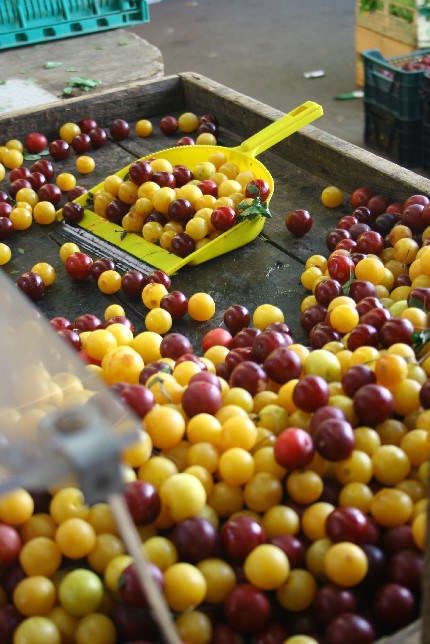
These plums are the first ones to arrive on the summer market. They get their name from the fact that they are ripe for the festival of St. Jean, the third week of June. They are for sale only for a week or two.

I picked up a scoop on the way to meet a friend for coffee yesterday, knowing it was probably my last chance this year, and my 59 centimes went a long way. My friend and I made a pretty good dent into the lot when I put them on the table between us, but there were still a few dozen left that I carried home like a kid with a sack of candy. We had to finish them after dinner tonight because tomorrow they'll be too ripe.

They are like little sunbursts of flavor, with a sweet juicy inside and a nice pithy skin that you can chew on after you've sucked the inside out. Apparently, the tree for this fruit has in many regions been hit at the roots with a fungus and attempts are being made to salvage the variety with grafting, but success has been spotty. The man who sells them has been at the market every year right on time with his plums since we came to Lyon. We enjoy them fully, savoring each one, not knowing if he will come back with a harvest next year.