 Toulon, Var
Kamis, 11 Mei 2006

Minggu, 07 Mei 2006

Jumat, 05 Mei 2006
Lunch at Café des Fédérations

Café des Fédérations is on our list of places to take visitors in town that are interested in eating in a Lyonnais bouchon. There are so many restaurants in Lyon that have the “Official Lyonnais Bouchon” label, but so few that really give a good quality sampling of the specialty dishes of Lyon and the region. Many of the restaurants in Vieux Lyon are faking it with inferior industrial products and the tourists are none the wiser.
We arrived without reservations, hoping for a table and got lucky. When we were seated, and before we ordered, three dishes, served family style, were served – Caviar de la Croix Rousse, named after the neighborhood on the hill, which is simmered lentils served with chopped shallots and vinaigrette, Salad de Museau, a charcuterie salad of brined beef muzzle, sliced thin and served with a caper vinaigrette, and an assortment of saucisson sec (dried sausage) and pickles. While we sampled these dishes, the waiter came out and let us know what was on that day: Tete de veau (that’s veal head), pork cheeks, tablier de sapeur (the flat cut of tripe which has been cut into a rectangle and fried), andouillette (chitterling sausage Lyonnais style), chicken in vinegar, quenelle, boudin noir (blood sausage), gâteau de fois de volaille (a serving sized poultry liver terrine, prepared with the white livers from the poulet de Bresse).
Loic’s andouillette was perfect and the kind we like, Alison’s pikefish quenelle indeed was the good kind (although the sauce Nantua was a bit reduced and salty), my pork cheeks in red wine sauce were divine (photo above), and Rick’s chicken in vinegar sauce was just right. The service was breezy and attentive, and the Côte du Rhone was surprisingly good - meaning the quality was velvety and rich and seemed better than the cost of the regular pot they offer, if I didn’t know any better, I’d think we were being given something better than we ordered.
We have instinctively sought out the best vendors of products like the Lyonnais quenelles, andouilette sausages, and cheeses here in Lyon over the years. My brother-in-law Sebastien, first guided by his very Lyonnais grandmother, instructed us to seek our quenelles at Le Petit Vatel in the 6th, and ever since we have always done so. It was nice to see that the quenelles served at the Café des Fédérations came from this supplier. We get our andouillette from Bobosse at Les Halles in the 3eme, and when we have a special cheese plate that includes chèvre or mountain cheeses, we always go to Le Cellerier, also at Les Halles - these two vendors also suppliers to this bouchon.
The cheese plate was a cute assortment of only local cheeses – the classic fromage fort in the center, which I actually tried and liked this time, St. Marcellin, a rustic tangy chevre which is macerated in Marc de Bourgogne with crunchy dried raisins full of seeds called the Arôme Lyonnais (I have seen more tame versions of this cheese constructed with seedless sultanas and merely painted with Marc by the cheese boy in fancy restaurants, no doubt inspired by this classic cheese), and a Picodon.
Desserts were very good, with an assortment of tarts and classic desserts on offer. The winner of the table was the pear simmered in red wine.
Lunch for 4 people was 98 euros with the standard family style appetizer of three dishes, a main course from the list above, a 'demi' and encore a 'quart' (because it was so good) of Cote du Rhone, cheese at will from the communal plate, and dessert. We will go there again.
Café des Fédérations
10-12 rue Major Martin
69001 LYON
04.72.07.74.52
Rabu, 03 Mei 2006

Senin, 01 Mei 2006
Figatellu / Figatelli
 Brigitte is fond of Corsican meat products, and has introduced us to many different types of sausage and smoked meats, one here, one there, each time we visit. This weekend we traveled down to the Cote d'Azur and sure enough on her terrace we were served a new one.
 The name of this Corsican sausage comes from the Italian fegato, meaning liver. Liver is the central element, and it is lightly smoked. This past weekend, we enjoyed the dried sausages with aperitif before Sunday dinner. We had a couple of fickle eaters who wrinkled their nose at the idea of figatelli since pork blood plays a role in giving it a dark color and rich taste. Of course we were delighted, because it meant more for us!
The Corsicans are really good at acheiving that fine balance between the flavor of the meat and smoke. The dried sausage was not intensely smoke flavored. Loic began to peel the casing off the sausage like paper because the drying process had made it quite hard. Chewing it was difficult. Someone at the table said he enjoyed to heat up fresh figatelli sausage and serve it on toast.
During our drive back home, Loic took a wrong turn and we found ourselves winding up a mountain road we'd never been on before. The road continued on and on but we were not concerned, we had all day to get home. The view was beautiful, and we barely saw a soul. I had one of those feelings, and told Loic that when we reached the top of the mountain, there would be a cheap restaurant with great food. He laughed out loud and told me that we would most likely not even find a town. Sure enough, just after reaching the top of the mountain, we reached a town. There was a bustling roadside cafe/bar/tabac that I knew was going to be good when I caught sight of the wood pile and outdoor fireplace. Strangely enough, we glided into a parking spot that seemed as if it was made for us, and arrived just in time to get the last table on the terrace. The clientele was a mix of locals that circulated among the tables and talked to one another, and people like us passing through. We enjoyed our lunch in the sun.
Since it was on the menu and fresh in our minds, Loic ordered the fresh Figatellu for the first time. What he was served looked a bit like boudin noir, but was strongly flavored with garlic and wine, completely different from little dried sausages we had the day before. One more thing to add to the list of things to try at least a few times to come to a real understanding of this sausage and its possibilities.
To make Figatelli at home:
Take one part each of fresh ham, pork liver, and pork fat and chop them finely. Season with 2 teaspoons of salt, 2 teaspoons of ground black pepper, and 2 ground cloves (about 1/4 teaspoon) per pound. Let sit overnight in a cool dry place. In the morning, crush 2 cloves of garlic per pound of meat, and put the garlic into a strainer - pour about 2/3 cup per pound quality red or rose wine over the garlic into the meat so that the wine takes the flavor of the garlic. Adding wine will reduce the shelf life of the sausage, but adds an interesting depth of flavor. If you plan to dry the sausage, don't add the wine. Stuff your sausage casings with the mixture and smoke the sausages. Place it in a cool dry dark place to rest. It can be eaten fresh, grilled or braised and serve with polenta or potatoes, or dried, to be eaten as an aperetif snack.
Kamis, 27 April 2006

Selasa, 25 April 2006
Reference: Spanish Iberian Ham
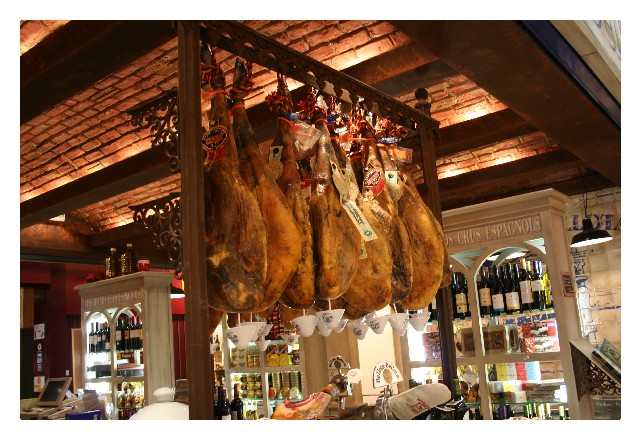
The way a pig is raised and what they eat makes a huge difference in the quality of the ham coming from the animal. Spanish Iberian hams are produced from a protected breed of pig descending from wild boars. These pigs are raised in herds instead of pens, out in the open, running free, grazing on the wild chestnuts and acorns, products of the wild forest environment, and herbs that are available to them. In the winter they forage for acorns from the cork oak with their long black snouts, in season and plentiful in the Iberian forest, and during that season, they put on their final weight.
There are three different types of Iberian ham, depending on the time of year the pig is born, August, Christmas, or Spring. The pigs have dark colored skin, they are brown or black in color, and have very little hair. They are slaugtered, depending on the time of year that they are born, between 8 and 13 months of age. The hams coming from pigs that have spent their last months out running in the forest, fattening up on foraged acorns are the ones that have the best flavor.
The Spanish Iberian ham has become a reference for the best cured ham in Europe. Here in Lyon, we are lucky to have a direct source for this type of ham at Les Halles.
Langganan:
Postingan (Atom)