Senin, 24 April 2006

Minggu, 23 April 2006
L'Ail est Arrivé! - Soupe au Pistou
 Soupe au Pistou is a dish I usually associate with sunburn. After a long hard day on that secret uncrowded stone beach we have to hike a mile over a steep hill to get to (no wonder we've got it to ourselves from time to time), we'd drag our tired sun soaked bones home and Brigitte would bring it out to the terrace in a big white ceramic bowl. The cicadas would hum as she ladled it into our soup plates, and the pink evening twighlight set in as we soothed our raging appetites with that and a chilled local rosé to match the sunset.
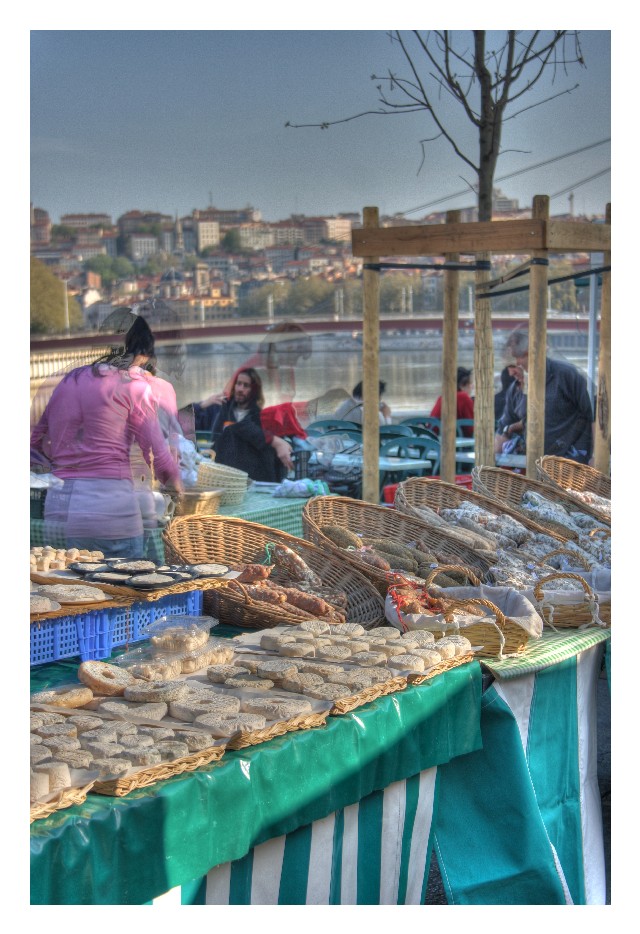
 The weather here has been so nice this weekend that this morning when I caught a whiff bright and early of the witchy ladies' fresh garlic I thought of this soup at once. We're seeing the fixings for it now, even in April, and there's no reason not to serve it up and ride this wave.
The fresh first garlic really does smell great even from far away. It is milder and juicier than the garlic we have been using all winter, and it's way too young to have a germ to have to fish out of the center! Toss the bitter and sad old leftover garlic pits sprouting green you have swimming in your onion basket! Take a head of this and roast it whole!
The following recipe comes from my mother-in-law Brigitte's kitchen notebook. She was born and raised on the French Cote d'Azur, and her mother gave her this recipe. The soup's origins are actually across the border and down the coast a bit in Genoa Italy, but it has been adopted and embraced as a local soup along the French eastern Med coast.
There really is no need to 'soup up' the traditional Pistou, which is a celebration of simplicity, really. It is a soup that hovers around the theme of a thickened garlic and fresh basil paste which is placed on the pedestal of a simple wholesome bean and potato soup. Don't fall for the fancy Parisian versions calling for 8 different vegetables or a rainbow display of imported hard to find beans in the stock. Forget the idea of drab winter tubers like leeks or onions in this light and uplifting soup! Please don't fall for posers calling for saffron, and don't feel like you need to go on a long shopping spree to make this soup. Remember what the goal is, keep it simple, and use what you have.
Soupe au Pistou
Take a pound of green beans cut into little pieces, a handful or more of freshly hulled feves or even peas if you have them, three or four potatoes cut into cubes, and two peeled and chopped tomatoes, and put them in a soup pot. Add 2 liters or a half gallon of water and add more to cover what you've got in the pot by at least one inch, if necessary. Season with sea salt, and bring to a boil. Lower the heat to a simmer for about 20 minutes, until the potatoes and the feves are soft. Add a cup of vermincelli or macaroni and continue to cook at a low simmer for another 15 minutes, making sure it does not burn on the bottom. The soup should be rather thick, the pasta soft.
About 5 minutes before serving, thoroughly mash (mash this to a pulp and do it by hand) 4 cloves of garlic with a few branches of basil (for the those who don't know pesto, I'll say 10 fresh basil leaves - for those who know pistou/pesto and have some experience with fresh basil and its strength variations, use your judgement), and add 3 or 4 tablespoons of good fruity olive oil one spoon at a time - whisking briskly like you're raising a mayonnaise (this means whisk it until it thickens up). Take a ladle of the soup and mix it into the pistou (garlic and basil mixture), and then mix all of that gently into the soup with a wooden spoon. Serve hot.
Note: Some like to serve their soup with Parmesean. Go ahead if that floats your boat! In my opinion, the cheese is best passed around and sprinkled onto the soup at the table.
Jumat, 21 April 2006
Getting the Grapefruit Spoons
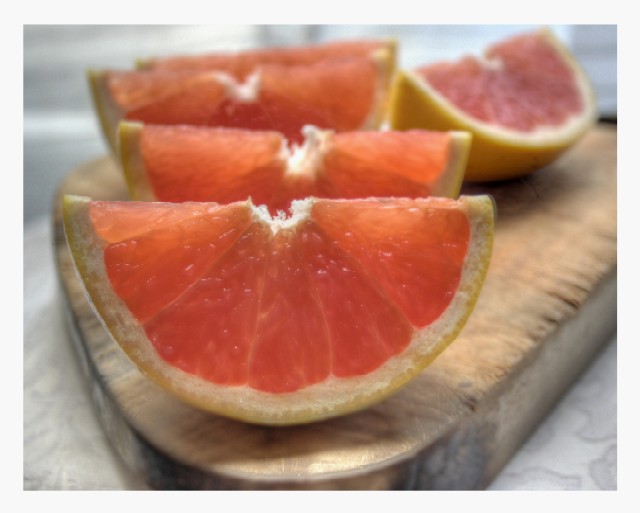 Something that made eating grapefruit fun when I was growing up were the silver grapefruit spoons we were granted permission to use. In the dark hour of morning, with the nimbus of gauzy diningroom curtains just barely aglow before sunrise, I would go into the formal dining room, face the buffet, and pull with all of my weight to get the silver drawer open. The silver drawer was a sacred kind of drawer. It seemed there were movable panels and secret compartments. In one place where you had to lift up a cover, was a stack of velvety thick cards with my full name engraved on them. The silver drawer had a special pretty smell. The wood was old and dry, and the felt lined grooves to stack each implement were the perfect size. The grapefruit spoons were off to the right, they were after the coffee spoons and they had a pointed tip. They made eating a grapefruit a breezy gentle affair, kind of like spooning sherbet from a natural bowl. When I was a kid, I hated eating grapefruit any other way.
 At some point we obtained a set of less formal grapefruit spoons, with bamboo handles and serrated edges. I think the idea was that they were less dangerous than the pointy silver ones, and their home was in the regular kitchen drawer. I adopted them readily enough but I don't really have special memories of using them except of when we needed a spoon and the only ones left in my 5 kid household were the grapefruit spoons. Scraping ice cream from the bottom of a bowl with a serrated grapefruit spoon is an exercise in futility. You might as well just lick the bowl.
I enjoyed using the silver ones to eat the fruit mainly because I was attracted to the silver drawer, and the ceremony of using the precious spoons. I remember the white pithy stuff being almost impossible to remove from the meat of the fruit when I was growing up. I think the fruit has changed somehow.
Senin, 17 April 2006
Bouquet Breadsticks

Last night since I had a rather large herb bouquet leftover from the market this weekend, I decided to fool around with some of phyllo dough, called brick in France, and herbs. I have enveloped goat cheese and sprigs of thyme before with success, and an idea came from a recipe in Régal, which uses a technique to make a quasi mille feuille using layers of this type of dough which has sprigs of dill appliquéd between two circles of the dough with clarified butter. The home cook is instructed to fastiduously cut the dough into 36 perfect circles. I skipped that, not being the perfect circle type. But I did like the pretty effect of applying the herb to dough.
First thing: Pure butter is just too greasy. I started cutting it down with some dry white wine, making an emulsion of wine and butter, testing each time in the oven. I found that about a 1:3 butter wine ratio did quite nicely and I still think that I could have cut way down on the butter. I finally ended up with some crispy light bread sticks by taking a rectangular sheet of dough, spreading a thin layer of the wine and butter mixture over 1/2 of it, lining up the edge of the sticky side with herbs up the edge, sprinkling the sticky side with sea salt, folding the dry half over and smoothing it, and then rolling the whole thing loosely into a cigar shape. These go together very quickly. I popped them into a hot oven, herb side down for about 3 minutes, and then flipped them over and baked for another 3 minutes.
They were crispy all the way through and entertaining to eat, and since they had different kinds of herbs: dill, chervil, soft spring thyme shoots, and chives, they tasted different with every crunch. I can imagine heaping a whole bunch into a big basket for a party. Another idea would be apply herbs under a transparent filo feuille to bread dough before baking. Rolls, a loaf of bread, or maybe even some kind of savory cake might be nice with this type of applied decoration. I'll try something like that very soon.

Minggu, 16 April 2006

Sabtu, 15 April 2006
Lake Trout with Spring Fennel Sorrel Sauté
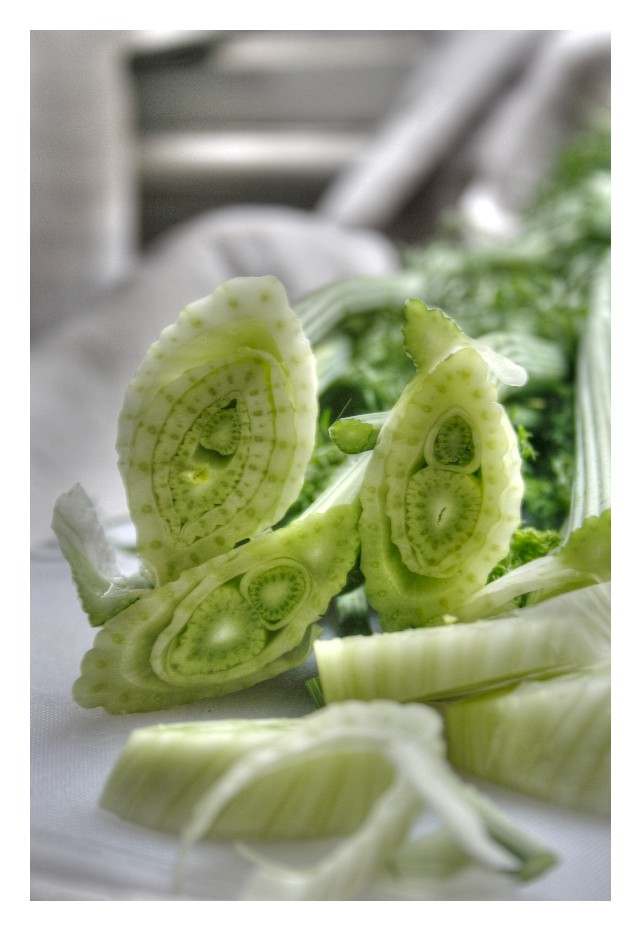
It's really all because of the baby fennel. I have had my eyes peeled for weeks and it has finally arrived. 
Asparagus Sorrel Soup


The Asparagus producer will be on the Quai St. Antoine for the next several weeks. Asparagus is just too delicious to hold back from buying. However much I love to pick up a long tender delicious tendril of freshly steamed asparagus and delicately eat it with my fingers, we can't really afford to do that at the moment. In order to still fully enjoy the taste of asparagus, I took advantage of the producers bargain bin, and bought some of the scraggly stems that cost 2€ a kilo. No need to worry, I know from experience that this will make a divine soup. We got some of the bottom rung asparagus, and I made sure to pick up a bunch of sorrel for 80 cents, among the other fresh new spring roots.


Asparagus Sorrel Soup
1/2 pound of asparagus
1 old potato
1 spring onion
1 small new carrot
1 tablespoon butter
a pinch of fresh thyme
2 european bay leaves or 1/2 california bay
sea salt
1/2 a bunch of sorrel, about 16 leaves
about 2 cups chicken stock (optional)
Wash your vegetables and herbs, and put the thyme and sorrel aside. Cut the ends off the asparagus but don't bother to remove any rough spots from the stems. Slice them into 1 inch lengths. Roughly slice your spring onion, including the green part, if it's fresh enough, peeled potato, and carrot into chunks. In a two quart saucepan, melt the tablespoon of butter, and once the foam subsides, add add the chopped asaparagus, onions, potato, & carrot. Over medium heat, sweat the vegetables until they begin to soften, about 5 mintues, stirring regularly. Toss in the thyme and the bay leaves.
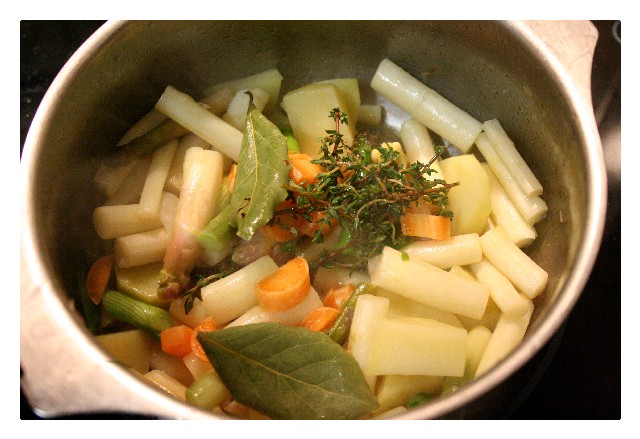 Add liquid to cover. If you don't have home made chicken stock, use water. (we used water today - don't be tempted to add bouillon powder or canned stock!) Bring to a boil, then reduce the heat and keep at a rather lively simmer for 15 mintues. At the end of the 15 minutes, remove the thyme and bay leaves. Use the blender to puree the soup thoroughly. Strain the soup through the chinois to remove any rough fibers.
  Rinse the pan right quick and return the puree to the pan and put it over the heat again. Roll your sorrel leaves into a cigar and quickly slice them thinly into ribbons. Bring the asparagus puree to a simmer over medium heat and stir in the sorrel leaves. When the leaves soften and lighten in color (about a minute), puree the soup again, taste, and season with sea salt only. Serve with crusty bread. This goes well with a simple wine like a Macon on the dry side or petit Chablis.
Langganan:
Postingan (Atom)